5 Reasons Acquirers and PSPs Are Switching to Android Payment Terminals
Listen to this article
Android payment terminals allow merchants to run business applications in addition to payments software. Merchants can add new features to their terminals as easily as selecting software from an app store, and acquirers can build and offer industry-specific solutions. Android also allows merchants to choose from a wider range of peripherals to complete their point of sale (POS) systems and have more payment estate management capabilities. As a result, Android can help acquirers and payment service providers (PSPs) attract more merchants and grow their businesses.
The market is seeing a definite trend of moving from terminals running on proprietary systems to flexible, open Android payment terminals. For example, IMARC Group reports that 40% of BBVA’s business customers had upgraded to Android point of sale (POS) terminals, as of October 2024. Several factors are driving the switch and giving acquirers new capabilities to enhance merchant experiences. manage payment estates, and grow their businesses.
What’s Driving the Transition to Android Payment Terminals?
Here’s what’s driving acquirers and other payment service providers (PSPs) to transition to Android payment terminals.
Using Payment Devices for More Than Payments
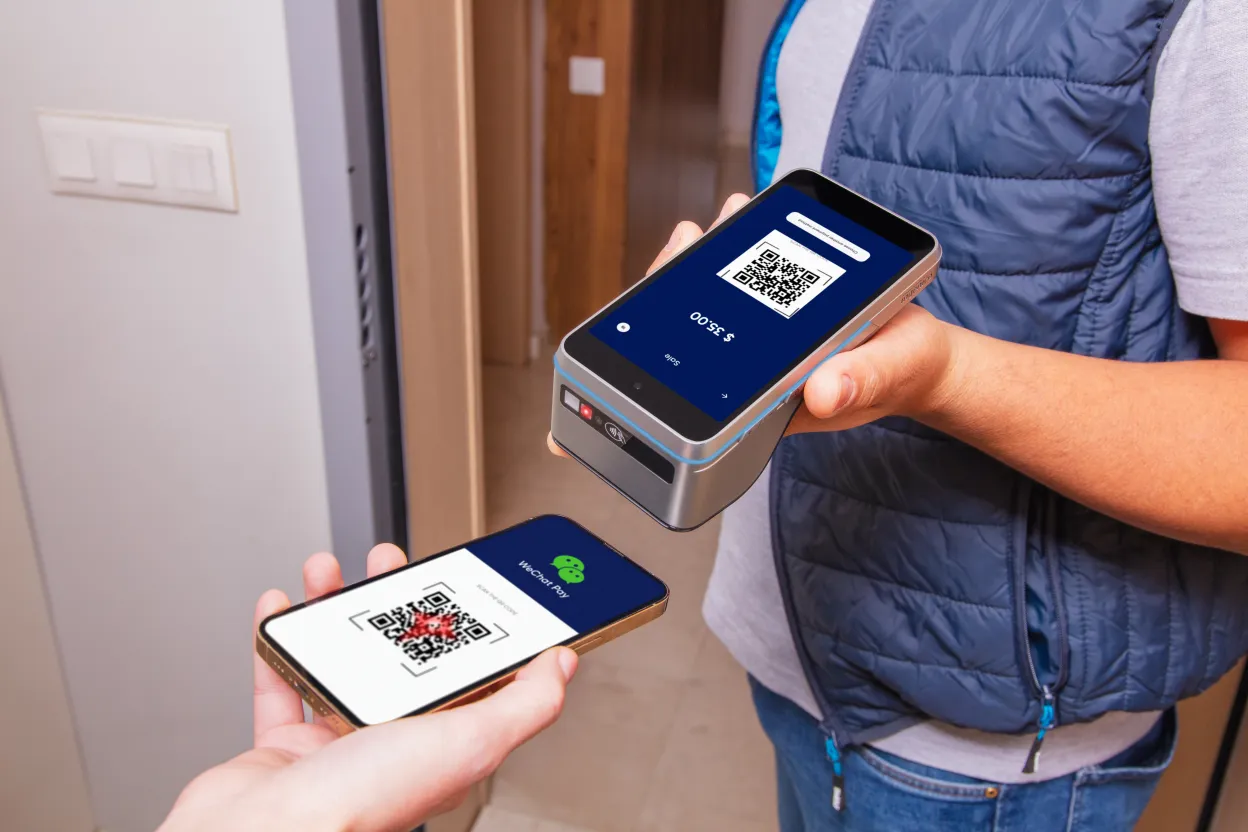
Android payment technology allows developers to give merchants a way to run business applications on their payment terminals while keeping payment data secure. Retailers, restaurateurs, and other merchants can use the Android terminal to power their loyalty rewards program, digital receipts, customer surveys, or other value-added services. They can even leverage that computing power to run software that helps them operate more efficiently, like inventory management software, or grow their businesses with customer engagement tools. Merchants can even choose to run their point of sale (POS) software on Android payment terminals to create a compact, portable system they can use anywhere in the store.
Simplifying Software Management for Merchants
With Android-based payment technology, managing software (and controlling software costs) can be easier. Instead of working with multiple vendors to build the tech stack a merchant needs to operate and meet customer demands, the merchant can add capabilities and features from the payment technology provider’s app store. These applications are seamlessly integrated with the payment platform, eliminating the need to maintain those integrations and software updates.
Offering Industry-Specific Solutions
Many developers are familiar with Android, which has created a broad pool of software based on this operating system. From those options, acquirers can create industry-specific solutions with the precise functionality that merchants need. For example, an acquirer can offer a restaurant solution that includes terminals that accept all the payment methods that diners prefer to use, mobile pay-at-the-table functionality, tipping functions, digital receipts, and integrated loyalty. Or, an acquirer could create an integrated solution for grocers that includes unattended payments for self-service kiosks, countertop Android payment terminals for assisted checkout, and mobile point of sale (mPOS) for service anywhere in the store.
Giving Merchants Peripheral Choices
Android is the most popular operating system in the world. StatCounter puts its current market share at 68.24%. But it’s not only popular in the consumer space. Much of the business world has moved to Android. Options for cash tills, barcode scanners, mobile devices, and scales are more abundant when the merchant has an Android-based system. With Android, merchants won’t feel locked into using only a finite number of devices or face complex integrations.
New Payment Estate Management Capabilities
The Android OS allows developers to take advantage of native features to enhance payment device management. An Android-based payment terminal management system can use geolocationing to track devices and even use geofencing to shut down the device if it leaves the store area. Android also enables real-time communication between payment devices and the management platform, which allows remote diagnostics and service for updates and troubleshooting. The result is peak performance and more device uptime.
How Offering Android Payment Terminals Impacts Acquirers and PSPs’ Businesses
Meeting market demands for flexible, integrated payment solutions can give acquirers and PSPs a competitive edge. This table summarizes the advantages of transitioning to Android payment technology.
|
Android Payment Terminal Capability |
Impact on Acquirer and PSP Businesses |
|---|---|
| Running business applications on the terminal | Meet merchant expectations for more value from their payment device investments. |
| Run applications that integrate with the payment terminal platform | Show cost savings by reducing software maintenance costs. |
| Industry-specific solutions | Increase merchant engagement and greater chances of winning business in the vertical market. |
| Easy peripheral integrations | Improving merchant satisfaction by giving more options for compatible devices. |
| Expanded payment estate management | Giving merchants more visibility into device health and faster, easier service when needed |
Acquirers Can Find New Markets through Partnerships
Another driver for the transition to Android is how businesses are buying merchant services. Independent software providers (ISVs) have become key strategic partners for acquirers. McKinsey & Company reports that ISVs have captured 8% of Spain’s merchant services market as of last year, and that number is likely to grow. 30% of the small and medium-sized enterprise (SME) merchant acquiring market in =Europe. Furthermore, McKinsey has found that merchant acquiring revenue is growing three times faster through the ISV channel than through traditional merchant services sales.
It’s easy to understand why merchants are looking for total POS and payment solutions. When they find POS software with the features they need to run their businesses, it’s even more appealing if it includes payments embedded or integrated with the system. A total solution means one point of contact, one person to call if issues arise, and one relationship for the back office to manage.
Acquirers who partner with ISVs to provide payments functionality can see an influx of new accounts from their loyal software users. And to work with most ISVs’ solutions, the payment technology must be Android-based.
Are You Ready to Make the Switch?
Android-based payment technology gives merchants more freedom to create total solutions that help them do business their way, with efficient, cost-effective tools. Acquirers and PSPs who provide those solutions, either directly or through ISV partners, can see greater merchant satisfaction and business growth.
Ingenico offers a full line of AXIUM Android payment terminals, supported by an adaptable, future-proof core system. Contact us to learn how AXIUM can meet your market’s needs today and prepare you for the future of commerce.
FAQs
Android provides a modern and flexible environment for payment applications and business services. Combined with the Next-Gen AXIUM platform, it enables intuitive user experiences, seamless application integration, remote software updates, and the flexibility to support evolving payment and business needs.
Our selection of Android devices is designed to cater to your every requirement. With intuitive user interfaces, they efficiently handle the most up-to-date business applications and are equipped with robust cameras to seamlessly accept all forms of payment methods.
Find out more about our alternative payment methods!
The Ingenico TETRA and Android AXIUM terminals differ in their operating systems and functionality. The TETRA range is powered by Ingenico’s proprietary operating system, designed for secure, fast, and reliable payment processing. It is ideal for businesses that need a straightforward, high-performance terminal for quick transactions. On the other hand, the Android AXIUM terminals run on the Android operating system, offering greater flexibility by allowing businesses to run custom apps for added functionality, such as loyalty programs, inventory management, and customer engagement.
Choosing between the two depends on your business needs. Opt for Ingenico TETRA if you require a dedicated, easy-to-use payment terminal focused solely on processing transactions efficiently. Choose Android AXIUM if your business needs a more versatile terminal that can handle both payments and other business applications, providing a broader set of features and greater customization. Both terminals offer secure, seamless payment processing, but the Android AXIUM offers added flexibility for businesses looking for a multifunctional solution.
Android‑powered payment technology is the backbone of a future‑ready checkout because it turns a traditional terminal into a flexible, updatable commerce hub. Ingenico’s AXIUM platform leverages Android to deliver a durable, high‑performance POS that can run a wide ecosystem of apps— from core payment processing to loyalty, digital receipts, and value‑added services— all while staying secure and PCI‑compliant through a modular, continuously‑updated OS. This open, developer‑friendly environment lets merchants integrate their own business applications via SDKs and APIs, roll out new features instantly, and adapt to emerging payment methods (e.g., QR‑code, BNPL, SoftPOS) without replacing hardware. The result is a consistent, scalable solution that reduces complexity, accelerates time‑to‑market, and ensures the checkout experience can evolve alongside consumer expectations and regulatory changes.