Biometric Payments: Why Palm Vein is the Best Choice
Listen to this article
Although there are biometric payment options, including fingerprint and facial scans, palm vein biometric payment is emerging as the best option. It’s secure, trustworthy, and secure. It’s also touchless, which makes it the most reliable and hygienic option. Benefits include checkout speed, appeal to digital-first consumers, integrations that streamline the payment flow, and creating a more sustainable operation.
Latin America’s biometric payments marketing is booming as retailers and solutions providers look for new ways to strengthen security while improving checkout experiences. The LATAM market is expected to reach more than $1.5 billion by 2031, growing at a 17.4% CAGR from $448 million in 2024. Growth drivers include the need for stronger identity verification, coupled with friction-free transactions.
Not all biometric payment technologies, however, deliver the same value and performance. Among the options available today, palm vein scanning is emerging as the most reliable and secure method for in-store transactions.
Types of Biometric Payments
Biometric payments use unique biological characteristics to authenticate transactions instead of using cards, PINs, or mobile devices. The top three biometric technologies commonly deployed are:
Fingerprint Authentication
Fingerprint recognition is one of the most familiar of biometric payments, commonly integrated with consumer smartphones and mobile devices. However, in retail environments, requiring consumers to touch shared sensors raises hygiene concerns and can lead to scanning errors when dirt or oil accumulates on readers.
Facial Recognition
These solutions allow users to authenticate payments without physical contact. While this technology has high adoption in regions like Asia, recent research studies have identified bias and misidentification, undermining consumer confidence.
Palm Vein Scanning
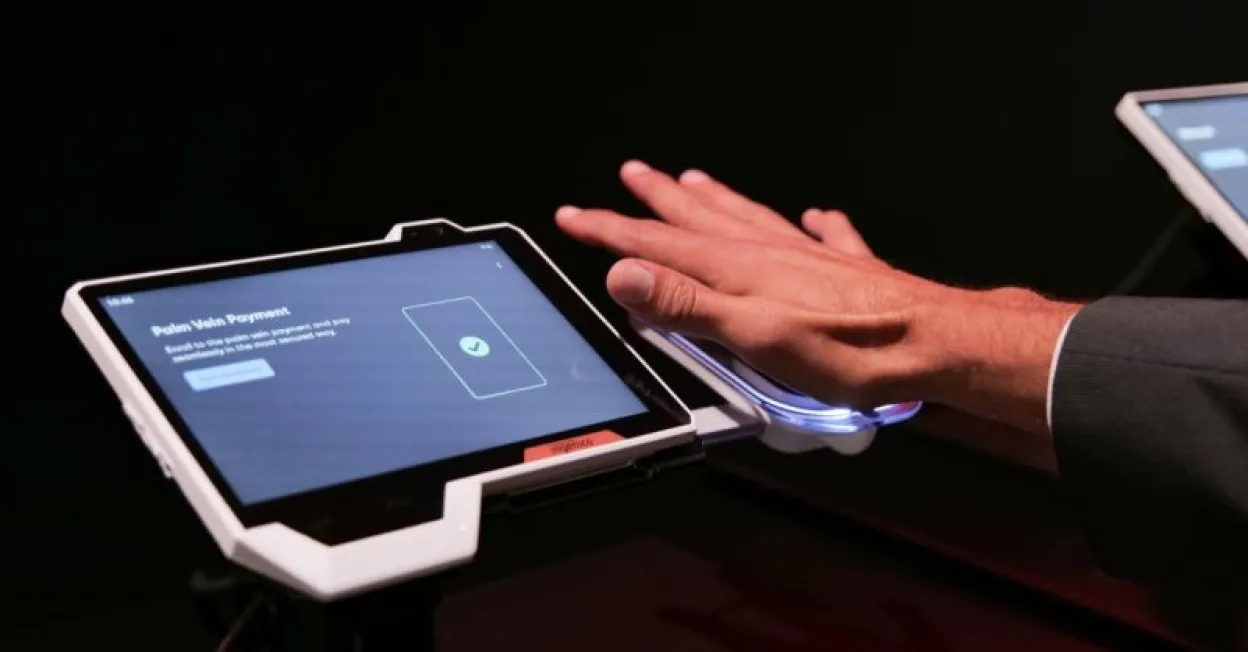
Palm vein authentication addresses many of the limitations of other methods. Palm vein uses near-infrared (NIR) sensors to capture the unique vein patterns inside a person’s palm, creating a digital imprint of them. Consumers simply wave their hands over a sensor at checkout to complete their transaction. The system compares the captured pattern with the encrypted palm vein “data map” stored during enrollment. A match authorizes the transaction instantly.
How Palm Vein Biometric Payments Solves Challenges
Among the biometric payment authentication methods available today, palm vein scanning stands out for its reliability, security, and ease of use. Features of palm vein scanning that solve challenges with other types of biometric payments are:
1. Touchless
Palm vein authentication does not require consumers to touch a shared surface, favoring instead the ability to hygienically wave a hand over a scanner, eliminating bad reads or delays from dirt and residue buildup on sensors.
2. Trustworthy and Consistent
Confidence in facial recognition has declined from 50 to 25 percent due to concerns about bias and misidentification, particularly among women and people of color. Palm vein scanning, however, is gaining trust because it relies on highly distinctive vascular patterns that allow for extremely accurate identity verification.
Palm vein patterns also remain stable over time. Unlike some biometric identifiers that can change with age or injury, the vascular structure in a person’s palm stays consistent throughout life. This stability makes it a reliable option for long-term payment programs.
3. Secure and Private
Biometric payments via palm vein are extremely difficult to forge compared to fingerprint biometrics that can be “lifted” from surfaces. Secure system design also plays an important role in protecting consumer data. Instead of storing an image of the palm scan, biometric payment platforms convert the palm vein pattern into encrypted data linked to tokenized payment credentials. This ensures sensitive information remains protected and helps meet security and compliance requirements.
The best palm vein biometric payment providers will engineer a solution built with privacy and data protection at its core, including:
-
Non-reversible Algorithms: A one-way algorithm prevents the recreation of a user’s original biometric scan.
-
PCI DSS Compliance: Tokenization of payment information means that data is not readable in the unlikely event of a breach.
-
Segmented Data Architecture: Separate databases are used to store biometric templates, tokens, and other personal information and card data, strengthening security and limiting access.
4. Easy
Using palm vein biometric payments is simple for both consumers to use and retailers to implement. After enrolling once, customers only need to hold their hand over the reader to complete a transaction, with no card, PIN, or smartphone required.
Real World Palm Vein Biometric Payment Use-Cases
Several real-world pilots demonstrate how palm vein technology works in practice. In Uruguay, solutions providers partnered to deploy a biometric payment program at Tienda Inglesa’s Red Expres stores. This allowed customers to enroll their palm vein patterns and link them to tokenized payment cards. When checking out, shoppers simply hold their hand over the scanner to authorize the payment.
In Brazil, a proof-of-concept program developed through a partnership between payment companies tested the technology with consumers who registered their palm vein patterns and linked them to their Visa or Mastercard accounts, completing purchases securely with a wave of their hand.
|
Feature |
Benefits |
|---|---|
| Fast payment authentication | Checkout lines move more quickly, and customer satisfaction increases. |
| Leading-edge technology | Payment processes appeal to younger customers, aligning well with Digital-native shoppers under 40. |
| Unique, non-reversible data | Actors cannot counterfeit a scan; the risk of fraud and chargebacks decreases. |
| Integrations | Merchants can streamline payment experiences by connecting with loyalty and digital wallet solutions, allowing several steps in the checkout process to occur simultaneously. |
| Sustainability | It reduces reliance on physical cards and paper, supporting a more environmentally friendly operation. |
| Flexibility | Palm vein biometric payments has the potential to streamline checkout in a wide range of use cases and industries. |
How to Take the Next Step with Palm Vein Biometrics
Biometric payments are quickly moving from pilot programs to real-world deployments. Among the available technologies, palm vein authentication offers the combination of speed, security, privacy, and simplicity required to deliver better checkout experiences.
Ingenico has developed solutions that enable secure palm vein payments and help businesses bring this innovative technology to market. Learn how biometric payments can transform the checkout experiences for your customers. Contact us today.
FAQs
Biometric payments are payment experiences that use a person’s unique biological traits—such as a fingerprint, palm‑vein pattern, facial features, or iris—to verify identity and authorize a transaction. Instead of a PIN, password, or card swipe, the biometric data is captured at the point‑of‑sale (POS) and matched against a secure template, instantly confirming that the shopper is the rightful owner of the payment method.
Biometric payment terminals store a digital template of these traits (never the raw image) and match it in real time to authorize the transaction. This eliminates the need for PINs or cards while delivering strong fraud protection.
Palm‑vein scanning protects payments by using a deep, invisible vascular pattern that is extremely difficult to replicate, coupled with hardware anti‑spoof measures and PCI‑compliant encryption. This makes it intrinsically more resistant to cloning, photography, or presentation attacks than surface‑level biometrics such as fingerprints or facial recognition.
Biometric payment terminals are engineered for payment‑grade accuracy: they meet industry‑approved security certifications, incorporate hardware anti‑spoofing, and (especially with palm‑vein) use an internal biometric that is inherently harder to fake. While the exact numerical FAR/FRR values are not disclosed in the public assets, the documented compliance and technology choices indicate very low error rates suitable for high‑volume retail and financial‑inclusion deployments.
Biometric payments give merchants a powerful tool to reduce fraud, speed up checkout, and reach new customer segments, while the primary risks are privacy compliance, implementation cost, and occasional usability hiccups—all manageable with proper processes and the support resources Ingenico provides.