How Android POS Terminals Improve Café Customer Experiences
Listen to this article
Upgrading to Android POS terminals allows cafés to streamline payments, accept a wider range of payment methods, and add mobile point of sale capabilities with portable Android terminals and SoftPOS. Android POS also allows cafés to integrate with intelligent promotion engines and analytics for hyper-personalized offers, and to transition to digital promotions and receipts for more sustainable operations.
A booming food and beverage sector in Portugal requires using optimal tools to deliver the best customer experiences. And for payment, the optimal tools are Android POS (point of sale) terminals.
For proof that coffee culture is an important part of Portugal’s society and economy, just look at the numbers. xMap reports that there are more than 20,000 cafés in the country. Eurostat data shows that’s the most per capita in Europe. Furthermore, cafés aren’t only a part of daily life and gathering places for residents in communities throughout the country. CoffeeBI reports that they’re tourist destinations filled with romance and history. For example, Café Nicola, a fixture in Lisbon since the late 18th century, has served customers in its current location since 1929. The Brasileria in Lisbon was a favorite spot for poet Fernando Pessoa, and Café Guarany in Porto upholds its reputation as “the musicians’ coffee shop” with events including Fado performances.
To delight both local patrons and tourists with exceptional experiences that include fast checkout, tableside service, payment method choices, and sustainable processes, deploying Android POS terminals should be a part of cafes’ business strategies.
Android POS Terminals Make Payments Fast and Low-Friction
Android POS terminals empower cafés to handle payments quickly. Modern Android POS devices are built for speed, but they also give cafés an additional advantage. Android allows operators to run business applications on the terminal to streamline customer interactions. Cafés can seamlessly integrate loyalty rewards, mobile payments like MB Pay, and digital receipts into a single flow. When customer interactions are well-orchestrated with an Android POS terminal, cafés can remove friction from the process of settling the check and keep the focus on enjoying a Bica or Cimbalino, even at peak breakfast or busy tourist hours.
Android POS Terminals Let Cafés Give Customers Payment Choices
Android POS terminals running on leading payment technology platforms allow cafés to accept the full range of payment methods, including alternative payments. Android payment devices can accept traditional credit and debit payments, and near-field communication (NFC) technology allows them to accept contactless and mobile wallet payments, which consumers demand. Banco de Portugal reports that the vast majority of payment cards now have contactless chip technology, and PaynoPain has seen an increase in digital wallet use, particularly among 18-35-year-old consumers.
Android POS also allows cafés to stay ahead of payment trends. For example, Ingenico’s AXIUM line of Android payment devices allows businesses to accept palm vein biometric payments by adding a peripheral device. The AXIUM line also includes unattended payment solutions, enabling cafés to offer self-service options that help keep lines short, save time, and give busy customers more control over their experiences.
Cafés Can Leverage Android POS Solutions for Tableside Service
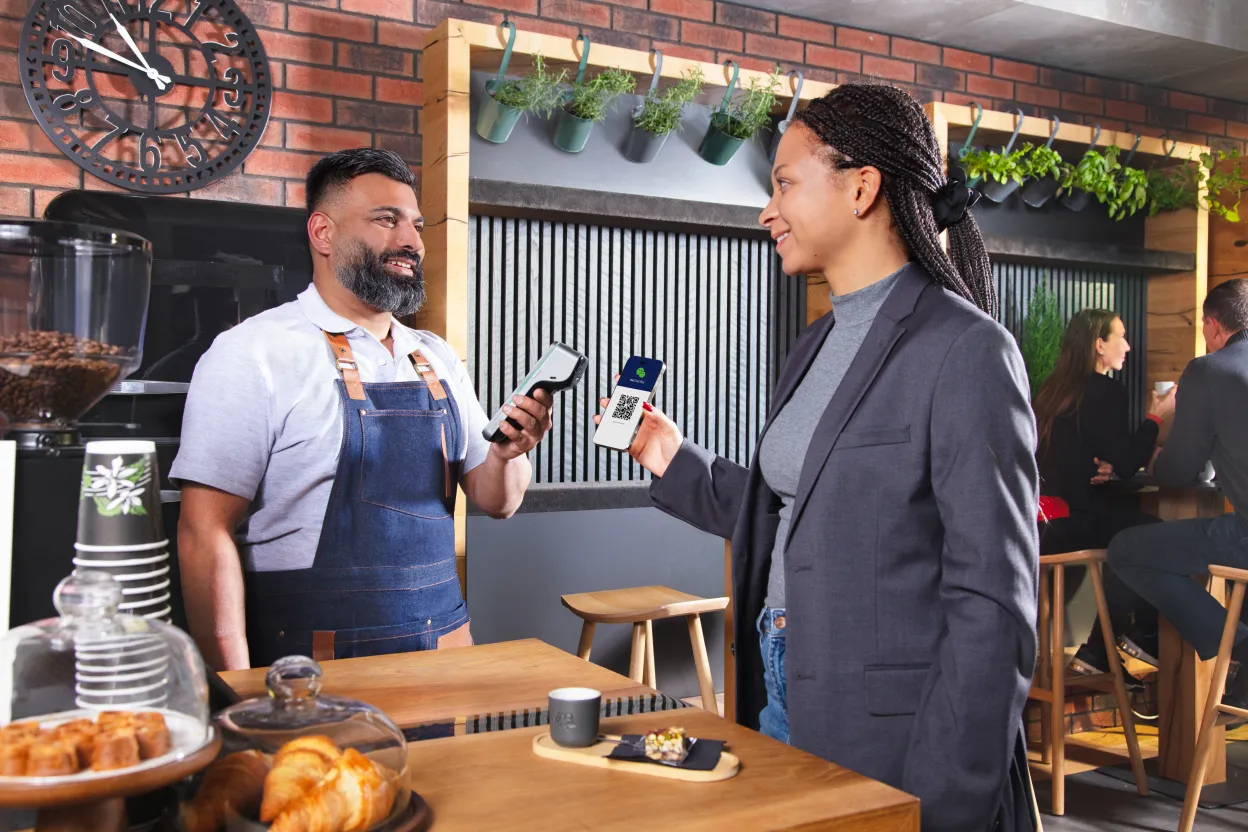
Portable Android POS devices are an ideal solution for pay-at-the-table solutions. A robust Android device allows servers to accept digital payments at the table, without requiring them to walk back and forth to a shared stationary terminal. Portable Android payment devices also make patio service easier and more convenient, allowing customers to enjoy their beverages outside. The server accepts a traditional, contactless, or QR code payment, receives approval, and provides the customer with a digital (or, when requested, paper) receipt. It’s convenient and quick for customers, but it also helps cafés turn tables faster, which can result in more revenues.
Leading Android POS technology can even allow servers to accept contactless payments directly on Android devices. With software-based point of sale technology, like Ingenico SoftPOS, cafés can upload the software onto the mobile devices they already use in their business, e.g., for communications or inventory management, and use them as payment terminals. It’s a cost-effective way to add pay-at-the-table service to enhance customer experiences.
Android POS Lets Cafés Personalize Promotions
Android gives innovators the opportunity to help cafés take service to a new level of personalization. Cafés can use Android terminals to connect with intelligent tools that help them track loyal customers’ purchases, make personalized offers based on their preferences, and offer digital coupons customers can store in their mobile wallets and use on future purchases. These capabilities help independent cafés compete with enterprise chains that make the most of customer data to increase loyalty and sales.
Digital Promotions and Receipts Equal Greater Sustainability
Android POS technology allows cafés to transform traditional manual and paper-based tasks into digital processes. Cafés can replace paper with digital receipts, issue coupons via text, app, or email, and even digitize internal processes to reduce paper costs. Digitizing processes is another step companies can take to meet EU sustainability and national sustainability requirements. However, prioritizing sustainability is also important to customers. According to the European Investment Bank, 84% of Portuguese consumers favor stricter measures to protect the environment.
The Benefits of Android POS Terminals for Cafés, in Summary
While legacy payment terminals allow cafés to meet customers’ expectations to use digital payments, Android POS technology gives cafés more flexibility and advanced features that they can use to deliver the best possible experiences when local patrons and tourists stop by for their favorite espresso drink.
|
Android POS Features |
Café Operational Enhancements |
|---|---|
| Powerful processors and robust memory | Fast transactions and the ability to run business applications from the terminal for unique, streamlined payment flows. |
| Flexibility to accept the full range of payment methods | Acceptance of all popular payment methods and the freedom to add emerging payment types, including QR codes and other alternative payments. |
| Mobile POS capabilities | Pay-at-the-table service inside the café or on the patio |
| Integration with intelligent promotion engines and analytics | Personalized offers that build loyalty and increase revenues |
| Digitized processes for issuing coupons and receipts | More sustainable operations for regulatory compliance and alignment with customer values |
Overall, Android POS terminals give cafés a path to modernizing customer experiences while continuing to serve the foods and beverages and maintain traditions that local patrons and tourists love. To learn more about the benefits of Android POS terminals for your café, contact us.
FAQs
Android POS terminals (AXIUM Android) run a unified Android OS that can host any payment‑application that follows the device’s SDK, so merchants can install and run local or alternative payment apps (e.g., QR‑code wallets, NFC‑based contactless schemes, country‑specific mobile wallets, prepaid or voucher solutions) side‑by‑side with traditional EMV card apps. Because the platform is open, the same terminal can present the customer with multiple payment options on the screen, route each transaction through the appropriate gateway, and settle them in a single flow—letting you accept cards, local digital wallets, QR‑based payments, and other emerging methods without needing separate hardware.
Acquirers can turn Android POS terminals into recurring, services‑driven profit centers by bundling SaaS‑style value‑added apps (loyalty, digital receipts, BNPL, analytics) on top of the payment flow, offering subscription or usage fees that scale with merchant volume. They can also deploy SoftPOS to let any Android device become a secure, contact‑less acceptance point, which reduces hardware CAPEX and creates new per‑device or per‑transaction licensing revenue. Acquirers can embed payments and banking experiences (in‑store wallets, account‑to‑account, tokenised card‑on‑file) directly into the Android app ecosystem, unlocking fees from embedded finance products. They can also monetise the rich sales and customer‑behavior data generated by these terminals through premium analytics dashboards or data‑as‑a‑service offerings.
Android POS terminals are built for self‑service and unattended use through rugged, weather‑proof enclosures (IP65/IK09), universal payment acceptance (chip‑&‑pin, contactless, QR, NFC, etc.), and modular hardware that can be tailored with readers, cameras or printers for kiosks, vending or parking stations. Cloud-based Payment terminal management services (Ingenico 360) enable remote updates, health monitoring and subscription‑based value‑added features, while the Android OS (e.g., AXIUM SX series) provides on‑device AI capabilities for fraud detection, personalized upselling and predictive maintenance, delivering a secure, flexible and revenue‑generating solution for unattended environments.
Android‑powered Ingenico terminals (AXIUM Android) are managed through Ingenico 360, a cloud‑based estate‑management platform that gives you a single pane of glass for thousands of devices. It centralises onboarding, configuration and software updates, provides real‑time health dashboards, remote diagnostics and remote‑desktop access, and lets you enforce policies (MDM, geofencing, access controls) across the whole fleet. Because the terminals run a uniform Android OS, updates and new business apps can be pushed instantly to every device, eliminating manual installs and reducing downtime, which dramatically simplifies large‑scale estate operations.
Android‑based POS terminals ready merchants for biometric authentication by integrating certified fingerprint sensors that enable on‑device enrolment and verification, offering a simple toggle in the user interface to activate biometric checks per transaction. The devices feature IP‑rated, hardware‑based spoof detection and comply with global standards such as FBI PIV IQS, ISO 19794‑4 and FIPS 201, allowing merchants to add fingerprint verification without additional hardware or complex integration. This optional biometric layer enhances security, streamlines checkout, and positions the solution as future‑ready while maintaining PCI‑PTS certification.